The Silent Exit: How an Uncomfortable Shopfront Quietly Drains Revenue from London's High Streets
Walk down any London high street in late July and you will notice a pattern. Some shopfronts hold their customers; others shed them. The difference is rarely the product on the shelves or the coffee in the cup. It is the temperature at the door.
Retail and hospitality operators spend considerable sums on branding, merchandising and staff training, yet the climate inside their premises is frequently treated as an afterthought — something to be addressed when it fails, not when it matters. This is a commercial error, and it is one that costs London businesses more than most realise.
The Customer You Never Knew You Lost
The most damaging effect of poor climate control is invisible in the day's takings. A shopper who steps into an overheated boutique, waits thirty seconds, and turns back to the street does not register as a lost sale. A couple who choose one café over another because the first has a wall of heat pouring through its open door will never mention it to the owner.
Research into consumer behaviour consistently shows that ambient discomfort shortens dwell time. In hospitality, dwell time is revenue: the second coffee, the dessert, the return visit. In retail, it is the difference between browsing and buying. When the internal environment is unpleasant, none of the other investment in the business can compensate. Staff suffer too — service quality deteriorates in conditions that would breach workplace temperature guidance, and staff turnover in hospitality is already high enough without adding an avoidable grievance.
The Noise Problem Next Door
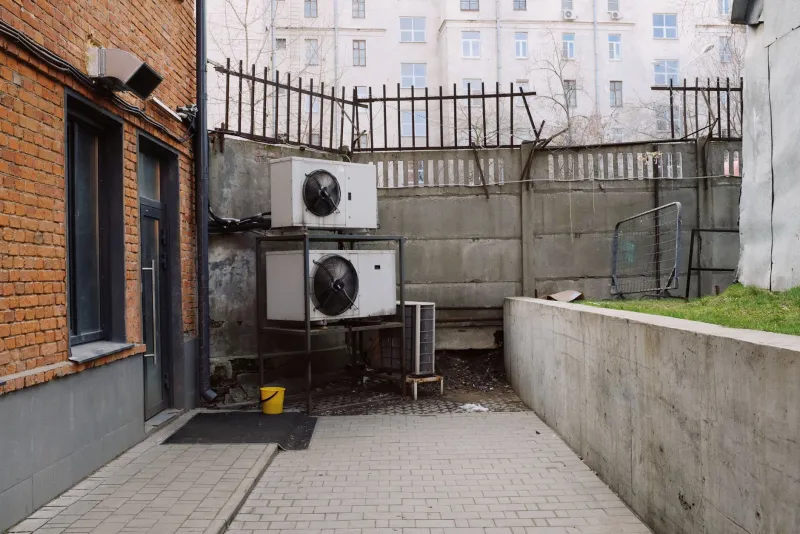
Then there is the other side of the wall. External condenser units, bolted on as a hasty retrofit, are among the most common sources of neighbour complaints reaching London borough environmental health teams. A unit mounted carelessly above a residential flat, humming through the small hours, can generate noise abatement notices, enforced remediation and, in serious cases, requirements to remove equipment entirely.
For a business, this is the worst of both worlds: the capital outlay has been made, but the system cannot legally or peacefully operate. Well-planned installations avoid this entirely — through careful siting, acoustic casing, anti-vibration mounts and, where necessary, units specified for low sound output. These considerations cost a fraction at the design stage of what retrospective correction costs after a complaint.
Retrofit Versus Fit-Out
The financial argument is straightforward. Integrating air conditioning during a shop fit-out — with ceilings open, access straightforward and trades coordinated — is markedly cheaper than retrofitting the same system into a finished premises. Retrofit work means disruption to trading hours, cosmetic repair, and often compromise on equipment selection because of access constraints.
Yet the pattern on London's high streets remains consistent: climate control is deferred until the first sustained heatwave, at which point every contractor is fully booked, lead times stretch, and the business endures another summer of lost custom while waiting for installation. Planning ahead converts an emergency into a schedule.
What Forward-Thinking Operators Should Do
A sensible approach for any retail or hospitality premises in London includes three elements. First, treat the cooling and ventilation load as part of the fit-out specification, assessed alongside lighting and layout rather than after opening day. Second, consider heat pump systems that provide both heating and cooling — London's shoulder seasons demand both, and a single reversible system is more efficient than separate solutions. Third, ensure installation and maintenance are carried out by qualified engineers, with noise impact assessed before equipment is ordered, not after a neighbour complains.
The shopfront that keeps its customers through a hot August afternoon is not lucky. It is the product of a business decision — one made months earlier, by an owner who understood that comfort is not a luxury. On a competitive high street, it is infrastructure.
If you are planning a fit-out or reassessing your premises' climate control, London Nitro Heating & Cooling provides design, installation and maintenance for commercial cooling systems across the capital. An early conversation is considerably cheaper than a summer of empty chairs.