Precision at the Point of Installation: Why Nitrogen-Assisted HVAC Commissioning Sets a Higher Standard for London's Buildings
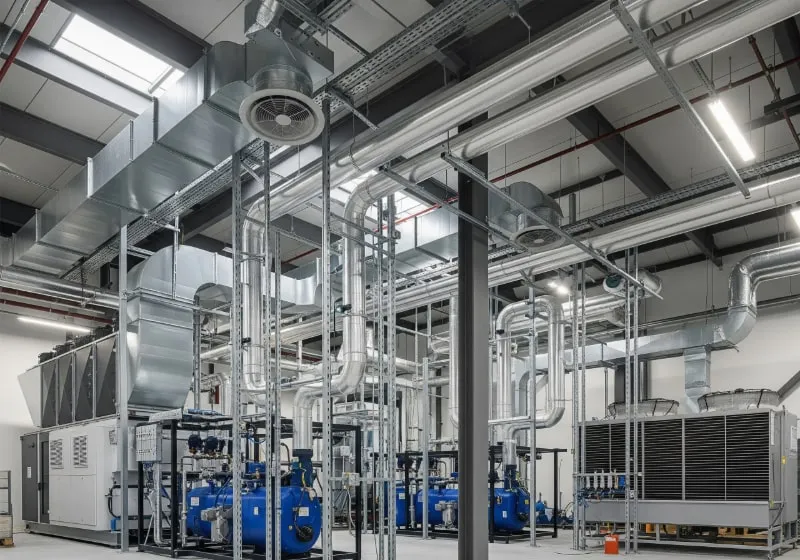
Photo: HVAC engineer commercial building installation refrigerant pipework London, via www.georgebenson.co.uk
The Moment That Defines a System's Future
In HVAC engineering, the commissioning phase is frequently underestimated by those outside the industry. It is the point at which a newly installed system transitions from a collection of components to a functioning, integrated whole — and the rigour applied during this process has a direct and lasting bearing on how that system performs for years, sometimes decades, to come.
Traditional commissioning methods have served the industry adequately for many years. However, as building complexity increases, as refrigerant regulations tighten, and as clients demand ever-higher standards of reliability from the climate control infrastructure they invest in, the limitations of conventional approaches have become increasingly apparent. Nitrogen-assisted commissioning — the methodology that sits at the core of London Nitro's installation practice — addresses those limitations directly.
What Nitrogen Commissioning Actually Involves
To understand why this method matters, it is worth establishing clearly what it entails. During the installation of any refrigerant-based HVAC system, the pipework and components that will carry refrigerant must be thoroughly cleaned, tested for integrity, and prepared to receive the working fluid without contamination.
In standard practice, this preparation involves pressure testing with dry nitrogen gas to check for leaks, followed by evacuation of the system using a vacuum pump to remove moisture and non-condensable gases before refrigerant is introduced. Nitrogen-assisted commissioning extends and refines this process considerably. Dry nitrogen is used throughout the installation — not merely at the pressure testing stage — to purge the system's internal pipework as work progresses. This means that at no point during the installation are the pipe interiors exposed to atmospheric moisture or oxygen for any sustained period.
The significance of this seemingly straightforward distinction is difficult to overstate.
Why Atmospheric Contamination Is a Serious Concern
Refrigerant systems are exceptionally sensitive to contamination. Moisture, in particular, poses a severe risk. When moisture enters a refrigerant circuit, it reacts with the refrigerant and the compressor lubricant to form acids — compounds that corrode internal components, degrade seals, and progressively damage the compressor, which is the most expensive single component within the system.
Oxygen contamination carries its own risks, contributing to oxidation of internal surfaces and the formation of non-condensable gases that reduce system efficiency and elevate operating pressures. In London's climate, where systems cycle frequently between heating and cooling modes and where ambient humidity levels are rarely low, the potential for moisture ingress during installation is a genuine and material concern.
Conventional commissioning practice mitigates this risk through the evacuation process, but evacuation addresses contamination that has already entered the system. Nitrogen purging prevents that contamination from entering in the first place. The distinction is analogous to the difference between treating a wound and avoiding the injury — both have value, but prevention is categorically preferable.
The London Context: Why This Matters More Here
London's building stock presents a set of challenges that make robust commissioning methodology particularly important. The city encompasses everything from Georgian townhouses and Victorian commercial buildings to post-war concrete structures and contemporary glass-fronted developments. Refrigerant pipework in these environments is frequently routed through complex, multi-floor pathways, often in spaces that are difficult to access once the installation is complete.
In a straightforward single-storey installation, a minor contamination issue might be identified and rectified relatively easily. In a multi-storey commercial building where pipework runs through voids, ceiling spaces, and service risers across several floors, the same issue becomes considerably more difficult and expensive to address. The operational disruption of returning to a commissioned and occupied building to investigate system performance problems is a cost that falls not only on the HVAC contractor but on the building operator and its tenants.
London Nitro's nitrogen-assisted approach is, in this respect, as much a commercial risk management strategy as it is a technical preference. By eliminating the most common sources of post-installation failure at the point of commissioning, it substantially reduces the probability of callbacks, warranty claims, and the reputational damage that follows from systems that underperform shortly after installation.
System Longevity and Efficiency: The Measurable Benefits
Beyond the prevention of acute failures, nitrogen commissioning delivers sustained benefits over the operational life of the system. A refrigerant circuit that has been installed and commissioned without contamination maintains its designed efficiency more consistently over time. The compressor operates within its intended parameters, refrigerant charge remains stable, and the system delivers the performance that was specified and paid for.
In commercial settings, where HVAC systems may run continuously for extended periods and where energy consumption is a significant operational cost, this efficiency retention has a tangible financial value. A system that loses efficiency gradually due to internal degradation will consume progressively more energy to deliver the same output — an invisible cost that accumulates steadily until a more visible fault eventually forces attention.
For building owners and facilities managers seeking to demonstrate responsible asset management, the commissioning methodology used at installation is an increasingly important consideration. Energy performance certificates, sustainability reporting, and the growing expectation of corporate environmental accountability all point in the same direction: systems that are installed correctly from the outset perform better, last longer, and cost less over their operational lifetime.
Establishing a Standard Worth Demanding
London Nitro's position on commissioning methodology is not simply a technical preference — it is a statement of professional standards. The HVAC industry, like any trade, contains a wide spectrum of practice. At one end are contractors who meet the minimum requirements of the specification and move on. At the other are those who apply the most rigorous available methods regardless of whether the client has specifically requested them, because they understand that the quality of the installation reflects directly on the quality of the outcome.
We believe that clients commissioning HVAC systems for commercial buildings in London — whether new installations, system replacements, or major retrofits — have every right to ask how their system will be commissioned and to expect a substantive answer. The question of whether nitrogen purging is used throughout the installation process is a reasonable and revealing one.
For those who have not previously considered commissioning methodology as a differentiating factor in their procurement decisions, we would suggest that it deserves closer attention. The cost of doing this properly at the outset is modest relative to the cost of rectifying problems that could have been avoided. In London's demanding commercial environment, where building downtime carries real financial consequences, the case for precision at the point of installation is a compelling one.