Chalk and Consequence: How London's Hard Water Is Quietly Wrecking Your Boiler
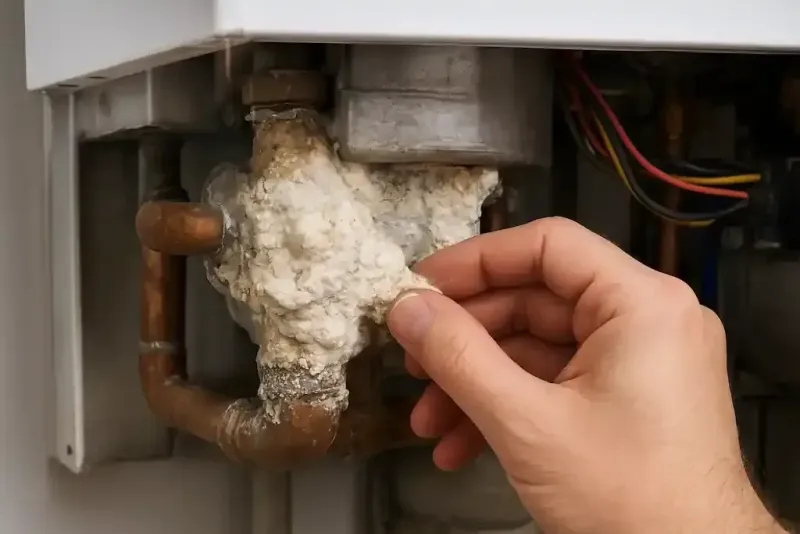
Photo: limescale buildup inside boiler heat exchanger pipes UK home, via lirp.cdn-website.com
A Problem Hidden in Plain Sight
Turn on any tap in Greater London and the water that flows through it has almost certainly travelled through chalk and limestone aquifers beneath the Thames Valley. That geological journey leaves a chemical signature: elevated concentrations of calcium and magnesium bicarbonates that make London's water some of the hardest in England, regularly measuring above 300 milligrams per litre of calcium carbonate in many boroughs.
For drinking purposes, hard water is largely harmless. For a domestic heating system, however, it represents a slow and largely invisible threat. Every litre of water that circulates through your boiler, pipework, and radiators deposits microscopic mineral particles as it heats up. Over months and years, those particles accumulate into the dense, chalky crust known as limescale — and once it takes hold, the damage compounds with each passing season.
The Science of Scale: What Actually Happens Inside Your System
When hard water is heated above roughly 60°C, calcium bicarbonate undergoes a chemical transformation, converting into calcium carbonate — an insoluble compound that precipitates out of the water and adheres to any surface it contacts. Inside a boiler's heat exchanger, where temperatures are consistently high, this process is relentless.
A limescale deposit of just 1.6 millimetres on a heat exchanger surface can reduce the component's thermal efficiency by as much as 12 per cent. At 6 millimetres — a thickness that can accumulate within three to five years in an untreated London system — that efficiency loss climbs towards 40 per cent. The boiler is working significantly harder to produce the same amount of heat, consuming more gas in the process and generating disproportionate wear on its internal components.
The problem is not confined to the boiler itself. Radiators accumulate sludge — a combination of limescale, rust particles, and magnetite — that settles at the base of each panel and creates cold spots. Pipework narrows as deposits build up along internal walls, restricting flow and forcing the pump to operate under greater strain. The cumulative effect is a system that is measurably less effective, noticeably more expensive to run, and considerably more likely to fail without warning.
Recognising the Warning Signs
Many London homeowners live with a degraded heating system for years without connecting the symptoms to limescale. The following indicators warrant prompt attention:
Unusual boiler noises. A persistent kettling sound — a low rumbling or hissing emanating from the boiler — is one of the most reliable indicators of limescale accumulation on the heat exchanger. As scale builds up, localised steam pockets form and collapse, producing that distinctive noise.
Cold patches on radiators. If the lower portion of a radiator remains cool while the upper section heats normally, sludge and scale deposits are almost certainly obstructing circulation within the panel.
Rising energy bills without explanation. A heating system losing efficiency to limescale will consume more fuel to maintain target temperatures. If your gas bills have increased without a corresponding change in usage patterns or tariff rates, reduced system performance may be a contributing factor.
Longer warm-up times. A system that takes noticeably longer than it once did to bring your home to temperature is exhibiting a classic symptom of scale-related heat transfer degradation.
Frequent pressure drops. While pressure loss has multiple potential causes, repeated drops in system pressure can indicate that scale damage has begun to compromise seals or internal components.
What Can Actually Be Done
The encouraging reality is that London homeowners are not without recourse. A range of interventions exists, spanning immediate protective measures to more comprehensive long-term solutions.
Magnetic System Filters
The installation of a magnetic inline filter — fitted to the pipework close to the boiler — is one of the most cost-effective protective measures available. These devices use powerful magnets to capture magnetite and other ferrous particles as water circulates through the system, preventing them from accumulating within the boiler or radiators. Leading manufacturers such as Adey and Fernox produce units specifically designed for domestic central heating systems, and installation is straightforward for a qualified engineer. A magnetic filter does not remove dissolved minerals from the water itself, but it significantly reduces the secondary sludge damage that compounds limescale problems.
Power Flushing
For systems already showing signs of sludge accumulation, a power flush is frequently the most effective remedial treatment. The process involves connecting specialist equipment to the heating circuit and forcing a combination of water and chemical cleaning agents through the pipework at high velocity, dislodging and expelling accumulated deposits. A thorough power flush on a typical London home typically takes between four and eight hours and should be followed by the addition of a quality inhibitor chemical to slow future buildup.
Inline Scale Inhibitors and Dosing Pots
Chemical inhibitors introduced directly into the heating circuit create a protective environment that discourages mineral deposition. Polyphosphate dosing units, fitted to the mains cold water feed, release small quantities of phosphate compound that interfere with the crystallisation process, reducing scale formation on heat exchanger surfaces. These units require periodic refilling but represent a relatively modest ongoing cost.
Whole-House Water Softeners
For households seeking the most comprehensive solution, a whole-house ion exchange water softener addresses the problem at source. These systems replace the calcium and magnesium ions responsible for hardness with sodium ions, producing genuinely soft water throughout the property. The benefits extend beyond the heating system to appliances, plumbing, and even skin and hair. Installation requires space — typically under the kitchen sink or in an utility area — and involves a connection to the mains supply and a waste drain. Running costs are modest, primarily involving the periodic replenishment of salt blocks.
It is worth noting that softened water should not be used for drinking or cooking without a separate unsoftened drinking water tap, a consideration that most professional installations accommodate as standard.
Scale Reduction Filters
For properties where a full softener installation is impractical, template-assisted crystallisation (TAC) filters offer an alternative approach. Rather than removing calcium and magnesium from the water, these devices convert the minerals into a crystalline form that does not adhere to surfaces. They require no salt, produce no wastewater, and need minimal maintenance — making them a practical choice for flats and smaller properties.
The Cost of Inaction
Boiler replacement in London typically costs between £2,000 and £4,500 depending on the unit and installation complexity. A heat exchanger replacement alone can run to several hundred pounds in parts and labour. Set against the relatively modest cost of a magnetic filter, an annual service, and a chemical inhibitor top-up, the financial case for proactive limescale management is straightforward.
London's geology is not going to change. The chalk beneath the city will continue to mineralise its water supply, and every unprotected heating system in the capital will continue to pay the price in reduced efficiency and premature failure. The difference between a boiler that lasts eight years and one that reaches fifteen often comes down to nothing more than consistent, informed maintenance — and the knowledge of what London's water is actually doing behind your walls.
If you are uncertain about the current condition of your heating system, or would like professional advice on the most appropriate scale management solution for your property, the team at London Nitro Heating & Cooling is available to carry out a comprehensive system assessment.