Installed But Idle: Why London Heat Pumps Are Failing to Deliver on Their Promise
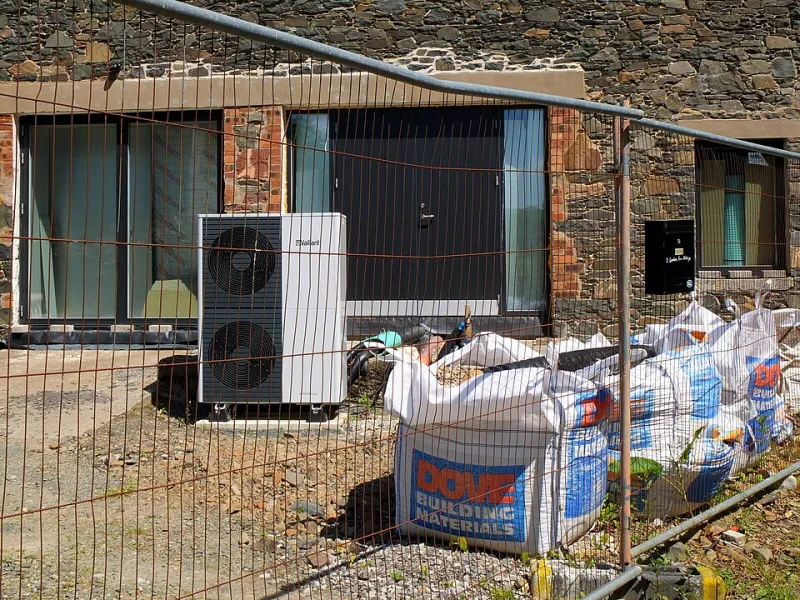
Photo: Jim Barton , CC BY-SA 2.0, via Wikimedia Commons
The government's push towards low-carbon heating has been emphatic. Subsidies under the Boiler Upgrade Scheme have made heat pumps more financially accessible than ever, and the marketing narrative is compelling: cleaner energy, lower running costs, and a meaningful reduction in household carbon emissions. Yet across London's residential streets—from Victorian terraces in Hackney to Edwardian semis in Ealing—a quieter story is unfolding. Homeowners who made the switch are discovering, often mid-January, that their new system is not performing as expected.
This is not a failure of ambition. It is a failure of preparation.
The Fabric Problem London Refuses to Acknowledge
Heat pumps operate on a fundamentally different principle to gas boilers. A boiler generates heat rapidly at high temperatures, compensating for poorly insulated walls, draughty sash windows, and single-glazed bay fronts with sheer thermal output. A heat pump, by contrast, produces heat at lower, steadier temperatures over longer periods. It is efficient precisely because it does not need to work hard—but only if the home retains what it produces.
London's housing stock is among the oldest in Western Europe. Approximately 38 per cent of the capital's homes were built before 1945, and a significant proportion predate even that benchmark. These properties were designed around entirely different heating philosophies. Solid brick walls, suspended timber floors, and minimal loft insulation are not incidental quirks—they are structural characteristics that fundamentally undermine the performance envelope of a modern air source heat pump.
When a heat pump is installed into an under-insulated property without a thorough thermal assessment, the system is placed in an impossible position. It runs almost continuously, struggling to maintain comfortable temperatures, and the homeowner faces energy bills that rival—or occasionally exceed—what they were paying with their old boiler. The technology has not failed. The retrofit has.
Undersized Emitters: The Hidden Culprit
Beyond insulation, one of the most common and avoidable installation errors in London retrofits involves heat emitters—the radiators or underfloor heating circuits that distribute warmth through a property. Traditional gas boiler systems typically operate with flow temperatures of 70°C or above. Heat pumps work most efficiently at flow temperatures of 35–45°C.
This difference is significant. A radiator sized for a high-temperature system will feel lukewarm when connected to a heat pump running at its optimal range. Homeowners instinctively turn the flow temperature up, which forces the heat pump to work harder, degrades its coefficient of performance, and erodes any efficiency advantage the system was meant to provide.
The solution—replacing or supplementing existing radiators with larger-surface-area alternatives, or installing underfloor heating where structurally feasible—is rarely inexpensive. But it is frequently omitted from retrofit proposals where competitive pricing takes precedence over system integrity. The result is a technically compliant installation that performs poorly in real-world conditions.
Why Professional Assessment Is Not Optional
The single most important intervention available to a London homeowner considering a heat pump is a detailed, property-specific assessment conducted before any equipment is specified. This is not a sales consultation. It is an engineering exercise.
A thorough assessment will examine the existing thermal envelope of the property, calculate heat loss figures room by room, evaluate the current distribution system, and identify whether the electrical supply can support the additional demand. It will also consider the orientation of the property, the practicality of external unit placement within the constraints of permitted development rights, and the compatibility of the proposed system with any existing hot water infrastructure.
Without this groundwork, even a well-intentioned installation is little more than an educated guess. And in a city where properties vary as dramatically as they do across London's 33 boroughs, guesswork is an expensive proposition.
Maximising What You Have Already Installed
For homeowners who have already made the switch and are experiencing underperformance, the situation is recoverable—though it requires honest diagnosis rather than incremental adjustment of thermostat settings.
The first step is to commission a performance review of the installed system. An experienced climate control engineer can assess whether the heat pump is operating within its designed parameters, whether the flow temperature is set appropriately, and whether the distribution system is adequately matched to the output. In many cases, relatively modest interventions—improving loft insulation, draught-proofing, adjusting system controls, or adding supplementary radiators in key rooms—can meaningfully improve comfort and efficiency without replacing the heat pump itself.
It is also worth reviewing the system's heating schedule. Heat pumps perform best when they maintain a steady background temperature rather than responding to large temperature swings. Many homeowners, accustomed to the on-off logic of a gas boiler, programme their heat pump in ways that work against its design. Re-educating the controls can yield noticeable improvements.
The Honest Conversation London Needs to Have
Sustainable heating is not a product. It is a system—and in London's context, it is a system that must contend with some of the most challenging domestic building stock in the country. The capital's net zero ambitions are legitimate and necessary. But achieving them requires honesty about what retrofitting older properties actually involves.
For some properties, a heat pump is genuinely the right solution today, provided the surrounding conditions are properly prepared. For others, a phased approach—improving fabric performance first, then transitioning the heating system—will deliver better outcomes and fewer disappointed homeowners.
At London Nitro Heating & Cooling, we believe that sustainable heating decisions should be grounded in the specific characteristics of each property, not in the prevailing enthusiasm for any single technology. The goal is not to install a heat pump. The goal is to create a home that stays warm efficiently, reliably, and affordably—whatever the season brings.