The Invisible Drain: How Leaking Ductwork Is Costing London Homeowners and Businesses Far More Than They Realise
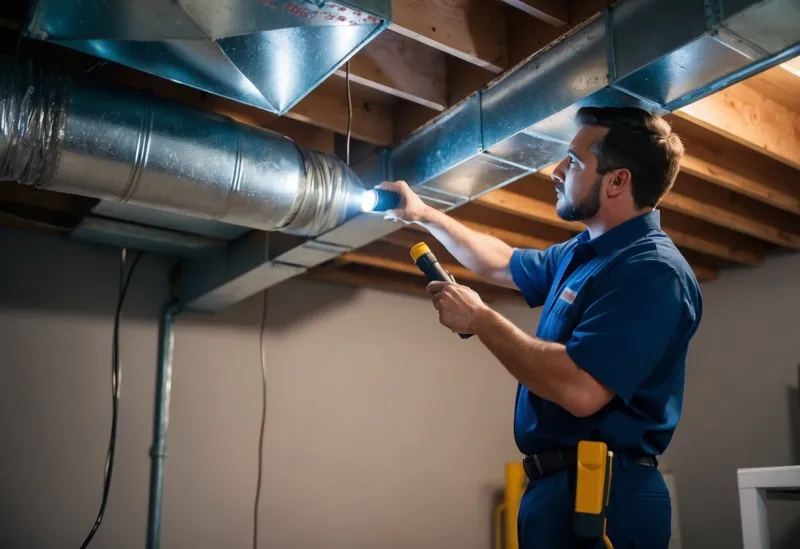
Photo: ductwork inspection leaking air ducts residential property, via oakhillhvac.com
The Problem Behind the Walls
There is a particular category of home improvement problem that persists precisely because it is invisible. Leaking ductwork sits firmly within this category. Unlike a dripping tap or a rattling boiler, a duct system that is haemorrhaging conditioned air produces no obvious symptom beyond a vague dissatisfaction with energy bills and an equally vague sense that certain rooms never quite reach the right temperature.
For the majority of London property owners, that vague dissatisfaction is as far as the investigation ever goes.
This is a costly oversight. Research from building performance organisations across Europe and North America consistently indicates that duct leakage in typical residential and light commercial properties can account for the loss of between twenty and thirty per cent of all conditioned air before it reaches the living or working space. In practical terms: for every pound spent heating or cooling a property, as much as thirty pence may be conditioning wall cavities, loft spaces, and service voids rather than the rooms the occupants actually inhabit.
Why London Properties Are Particularly Susceptible
Ductwork leakage is not unique to London, but several characteristics of the capital's building stock make it a more prevalent and more stubborn problem here than in newer or more uniformly constructed cities.
London's residential and commercial fabric spans several centuries of construction. Victorian terraces, Edwardian conversions, mid-century commercial blocks, and 1970s housing estates all present different duct installation challenges — and all share a common history of retrofitted mechanical ventilation systems installed without the benefit of modern sealing standards. When ductwork is added to an existing building rather than integrated during original construction, the compromises required to route it through existing structures frequently result in joints that are imperfectly sealed, connections that rely on ageing mastic or deteriorating tape, and sections that are simply inaccessible for routine inspection.
Add to this the thermal movement that London's seasonal temperature range imposes on building materials — duct joints that expand and contract repeatedly over years will eventually open — and the conditions for widespread leakage are clearly established.
What Standard Energy Audits Miss
One of the more frustrating aspects of ductwork leakage as a problem is how consistently it escapes detection through conventional assessment routes. A standard domestic Energy Performance Certificate, the document most commonly associated with residential energy assessment in England and Wales, does not include duct leakage testing. The methodology used to generate EPC ratings models a building's theoretical performance based on construction type, insulation values, and heating system efficiency — it does not measure what is actually happening within the duct infrastructure.
The result is that a property can carry a respectable EPC rating whilst simultaneously losing a quarter of its conditioned air to unintended spaces. The certificate says nothing meaningful about duct integrity, and most homeowners have no reason to suspect otherwise.
Commercial energy audits are somewhat more thorough, but duct leakage testing remains a specialist add-on rather than a standard component of most assessment packages. Unless a building manager specifically commissions a duct pressure test — a procedure that involves sealing the system and measuring pressure decay — the leakage rate will remain entirely unknown.
Recognising the Signs
Whilst definitive diagnosis requires professional testing, there are indicators that property owners and facilities managers can observe without specialist equipment.
Uneven temperature distribution across a building is one of the most common presenting symptoms. If certain rooms consistently fail to reach the thermostat set point whilst others overshoot it, duct leakage is a plausible contributing factor — conditioned air is reaching some areas of the system and not others, depending on where the losses are occurring.
Higher-than-expected energy consumption relative to comparable properties is another signal worth investigating. If a property's heating or cooling costs appear disproportionate to its size, occupancy, and insulation levels, the efficiency of the distribution system deserves scrutiny.
Excessive dust accumulation in rooms served by ducted systems can also indicate leakage. When ducts draw in unconditioned air from wall cavities or loft spaces, they may introduce particulates that would not otherwise enter the living environment. Persistent indoor air quality concerns in ducted buildings — unexplained odours, higher-than-expected humidity in some areas — warrant similar attention.
The Cost-Benefit Case for Remediation
The economics of duct sealing are more favourable than many property owners assume, largely because the baseline cost of inaction is so consistently underestimated.
Consider a London household spending £1,800 per year on combined heating and cooling energy costs. If ductwork leakage is responsible for a twenty-five per cent efficiency loss, the property is effectively spending £450 per year heating and cooling spaces it does not occupy. Over a decade, that represents £4,500 in avoidable expenditure — before accounting for energy price inflation, which has been far from negligible in recent years.
Professional duct sealing for a typical London residential property — using aerosol-based internal sealant technologies or manual joint remediation depending on system configuration and accessibility — typically falls within a cost range that delivers payback within two to four years at current energy prices. For commercial properties with larger duct networks, the absolute costs are higher but the proportional savings are consistent, and the payback timeline is often shortened by the greater volume of energy consumption involved.
It is also worth noting that duct remediation carries benefits beyond direct energy saving. Improved air distribution typically results in more consistent temperatures throughout a property, reduced strain on heating and cooling equipment (which extends system lifespan), and in many cases a measurable improvement in indoor air quality.
The Diagnostic Process
For property owners who wish to establish whether ductwork leakage is a significant issue in their building, the appropriate first step is a duct blower test — also known as a duct pressurisation test. This procedure involves temporarily sealing all supply and return registers, connecting a calibrated fan to the duct system, and measuring the rate at which pressure decays. The result provides a quantified leakage figure that can be benchmarked against acceptable performance standards.
At London Nitro Heating & Cooling, our diagnostic assessments include duct integrity evaluation as a standard component of comprehensive system reviews. Where leakage is identified, we provide a detailed remediation proposal that specifies the location and severity of losses and outlines the expected efficiency gains following repair.
Addressing the Problem Directly
Ductwork leakage is neither glamorous nor immediately visible, which is precisely why it persists at such scale across London's property stock. It does not trigger emergency call-outs or generate dramatic symptoms. It simply costs money, quietly and continuously, for as long as it remains unaddressed.
For homeowners seeking to reduce energy expenditure and improve comfort, and for commercial operators managing buildings against tightening efficiency requirements, duct integrity is a practical and often overlooked starting point. The losses are real, the remediation is achievable, and the case for investigation is straightforward.
The air you are paying to condition should be reaching the spaces you intend it to reach. If it is not, the sooner that is established, the sooner it can be corrected.