The Decibel Divide: How a Badly Sited Heat Pump Can Turn a Quiet Terrace into a Neighbourhood Dispute
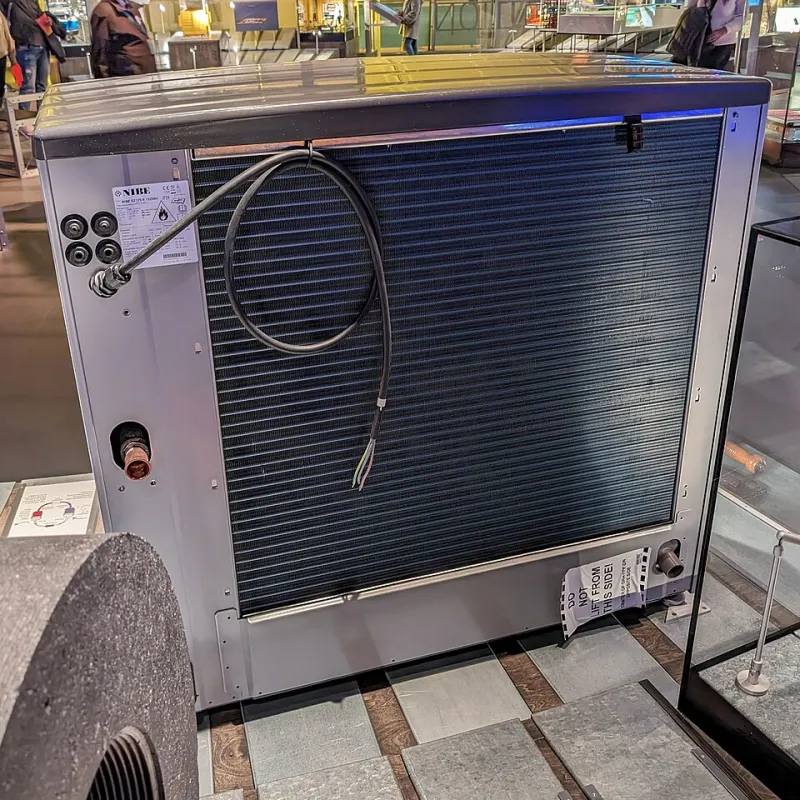
Photo: The wub, CC BY-SA 4.0, via Wikimedia Commons
London's streets are getting quieter in one sense and noisier in another. As gas boilers are phased out and air source heat pumps become the default choice for households seeking lower-carbon warmth, thousands of compact outdoor units are appearing on walls, in rear courtyards and beside garden paths across the capital. Alongside them sit the condensers of the air conditioning systems that an increasing number of Londoners now consider essential rather than indulgent.
For the most part, these machines hum along unnoticed. But in the narrow gaps between Victorian terraces, above the party walls of mansion blocks and across the shared courtyards of converted flats, noise has become one of the fastest-growing sources of neighbourly friction. Local authority environmental health teams report a steady climb in complaints about low-frequency hum, and disputes that once revolved around fences and parking spaces now centre on decibels.
Why Heat Pump Noise Catches People Off Guard
The problem is rarely the equipment itself. A modern, well-manufactured heat pump is a remarkably refined piece of engineering. The difficulty lies in context. A unit specified for a detached house in Hertfordshire may sit in open ground, metres from the nearest window. The same model crammed into a light well in Islington or a side return in Clapham behaves very differently.
Three factors combine to make urban installations problematic. First, sound reflects. Brick walls, fences and narrow passageways bounce noise back and forth rather than letting it dissipate. Second, background noise varies enormously by time of day; a hum that is inaudible at midday becomes conspicuous at eleven o'clock at night, when a heat pump ramps up to keep pace with falling temperatures. Third, low-frequency tonal noise — the sort produced by compressors and fans — travels through structure as well as air, meaning a neighbour may feel vibration through a wall long before they consciously register the sound.
The Rules: What the Law Actually Requires
Many homeowners assume that fitting a heat pump is a matter of picking a unit and booking an installer. In reality, most domestic heat pump installations in England fall under permitted development rights, but with conditions attached. The unit must typically be sited away from the property boundary, and — critically — the noise it emits should not exceed 42 decibels at the nearest habitable room window of a neighbouring property, measured at night.
That figure comes from the Microgeneration Certification Scheme (MCS) planning standards, and meeting it requires more than optimism. A competent installer should carry out a noise assessment before installation, using manufacturer data on sound power levels and accounting for distance, barriers and reflective surfaces. Too often, this step is skipped or reduced to a box-ticking exercise, which is precisely how disputes begin.
For commercial air conditioning and larger systems, the picture is stricter still. Local authorities may require full planning applications, and environmental health officers can act under the Environmental Protection Act 1990 if a unit is judged to constitute a statutory nuisance. Businesses in Westminster, Camden and other dense boroughs have been forced to replace or relocate condensers after complaints escalated — an expensive outcome that a proper acoustic survey would have prevented.
Siting: The Decision That Matters Most
In our experience, the majority of noise complaints trace back to a single decision made on installation day: where the unit was placed. The difference between a considerate installation and a contentious one frequently comes down to a few metres.
Sound practice looks like this. Units are positioned away from bedroom windows, both the occupier's and the neighbour's. They are set on anti-vibration mounts to prevent structure-borne transmission through walls and floors. Where space is tight, acoustic enclosures or low-noise fan modes — available on most quality equipment — are specified from the outset rather than retrofitted after complaints arrive. And in terraced streets, the installer speaks to the householder about what their neighbours will actually hear, not merely what the regulations permit.
There is also a seasonal dimension that is easy to overlook. A heat pump assessed in mild October weather may run harder and louder during a February cold snap, when the fan works against frost and the compressor cycles more aggressively. A responsible assessment accounts for worst-case operation, not average performance.
Resolving a Dispute Before It Hardens
Where a complaint has already been made, the worst response is silence. Low-level neighbourly irritation, addressed early, is usually resolvable; left alone, it tends to travel to the council's environmental health department, where it acquires legal weight.
Practical first steps include arranging an independent noise measurement at the affected window, checking whether the unit has drifted from its original mounting (vibration loosens fixings over time), and engaging a qualified engineer to review the installation. Often a modest intervention — replacement anti-vibration mounts, a revised fan curve, a simple acoustic barrier — brings the sound level comfortably within tolerance and restores relations.
A Quieter Way Forward
London's transition to low-carbon heating is necessary and, on balance, welcome. But it will only succeed at street level if installations are carried out with the same care given to their efficiency ratings. Noise is not an unavoidable side effect of electrified heating; it is a design consequence, and design consequences can be managed.
For households considering a heat pump or air conditioning system, the advice is straightforward: insist on a pre-installation noise assessment, ask where the unit will sit relative to neighbouring windows, and choose an installer who treats acoustics as part of the specification rather than an afterthought. For those already living beside a bothersome unit, a professional acoustic review is almost always cheaper than a dispute.
Good climate control should be felt, not heard. In a city where the walls between homes are measured in millimetres, that principle has never mattered more.